
Indian Institute of Drone Technology
भारतीय ड्रोन प्रौद्योगिकी संस्थान
Indian Institute of Drone Technology
भारतीय ड्रोन प्रौद्योगिकी संस्थान
Indian Institute of Drone Technology
भारतीय ड्रोन प्रौद्योगिकी संस्थान
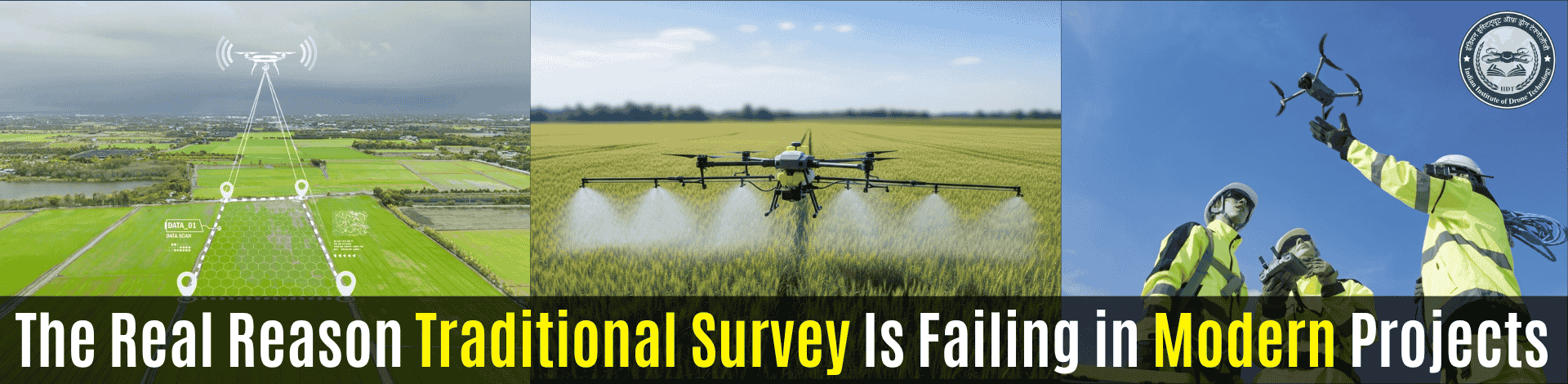
Traditional survey is failing due to speed and accuracy limits, while drone geospatial training is enabling faster, data-driven decision-making in modern projects.
Why are so many projects still facing delays, cost overruns, and land disputes despite careful planning? Students entering the drone field often ask this after seeing real project failures on site. The truth is simple: Traditional survey methods are no longer built for the scale and speed of modern infrastructure.
According to 2026 reports, over 40% of project delays are linked to inaccurate or outdated survey data. This is exactly where Drone Geospatial Technology Training in India is changing how projects are planned and executed.
Why Traditional Survey Is Breaking in Modern Projects?
Traditional survey fails because it cannot match the speed, accuracy, and scale of modern infrastructure demands.
India is building highways, smart cities, and industrial corridors at record speed. However, manual surveys still depend on ground teams, line-of-sight tools, and human estimation. Organisations like ISRO and DGCA are already pushing for data-driven mapping systems.
Expert Insight
Most companies overlook that survey is not just data collection. It is the foundation of every decision.
- Manual surveys take 5 to 10 days for medium sites
- Drone surveys complete similar work in 1 to 2 days
- Error margins drop from 5-10% to below 2%
- Rework costs reduce by up to 25%
A 2026 trend analysis shows that companies using drone mapping reduce project delays by nearly 30%.
Expert Quote
“Survey accuracy directly impacts project cost and timeline,” states a senior project advisor from an IIT infrastructure program.
How Drone Geospatial Technology Solves This Problem?
Drone mapping replaces manual errors with data-driven, high-resolution site intelligence. Drone systems powered by companies like DJI and computing platforms like Nvidia enable precise mapping using photogrammetry and GIS.
This is where Drone Certification Courses become important. Institutes like Indian Institute of Drone Technology train students in real-world mapping workflows, not just flying.
Expert Insight
Flying a drone is basic. Processing and analysing geospatial data is what companies actually hire for.
- Drone maps provide centimetre-level accuracy
- Data can be processed within 24-48 hours
- GIS integration enables real-time decision-making
- Large areas can be mapped in a single flight
According to 2026 reports, drone-based mapping improves project planning efficiency by 35-45%.
Expert Quote
“Drone data is no longer optional. It is becoming the baseline for modern surveying,” says a geospatial expert from a leading infrastructure consultancy.
Why Skills Matter More Than Tools in 2026?
The real gap is not technology, it is skilled professionals who can use and interpret drone data. India is facing a shortage of trained drone GIS professionals. While tools are available, execution depends on trained individuals.
This is where Drone Programming in India is gaining importance. The Indian Institute of Drone Technology is already integrating automation, AI, and mapping into training programs.
Expert Insight
Drone careers are shifting from pilot roles to data intelligence roles.
Fact Pack
- Demand for drone GIS professionals is growing 20-25% yearly
- Entry-level salaries are 30-50% higher than traditional survey roles
- Government projects increasingly require certified drone operators
- Skill-based hiring is replacing degree-based hiring
Here’s what the numbers reveal: Students with geospatial with drone skills get placed faster than those with only technical degrees.
Expert Quote
“The future workforce must understand both flying and data analytics,” notes a training head from a DGCA-approved institute.
Conclusion
Traditional survey is failing because it cannot keep up with the speed, complexity, and data needs of modern projects. Drone-based geospatial systems are not just improving accuracy, they are redefining how decisions are made. For students, this is not just a career option. It is a shift towards smarter, data-driven work. If you are passionate about drones, you are not just learning to fly. You are learning to see the world differently, and solve real problems that shape the future.
FAQs
1. Why is traditional land survey becoming outdated in India?
It is slow, error-prone, and not scalable for modern infrastructure projects.
2. What is the role of Drone Geospatial Technology Training?
It prepares students to collect, process, and analyse mapping data for real projects.
3. Are Drone Certification Courses necessary for jobs?
Yes, companies prefer certified candidates trained by institutes like Indian Institute of Drone Technology.
4. What is Drone Programming used for?
It is used to automate mapping, data processing, and advanced drone operations.
5. What career opportunities exist after drone geospatial training?
Students can work in infrastructure, mining, agriculture, urban planning, and smart city projects.
Leave a Comment
Your email address will not be published. Required fields are marked *

Comments