Indian Institute of Drone Technology
भारतीय ड्रोन प्रौद्योगिकी संस्थान
Indian Institute of Drone Technology
भारतीय ड्रोन प्रौद्योगिकी संस्थान
Indian Institute of Drone Technology
भारतीय ड्रोन प्रौद्योगिकी संस्थान
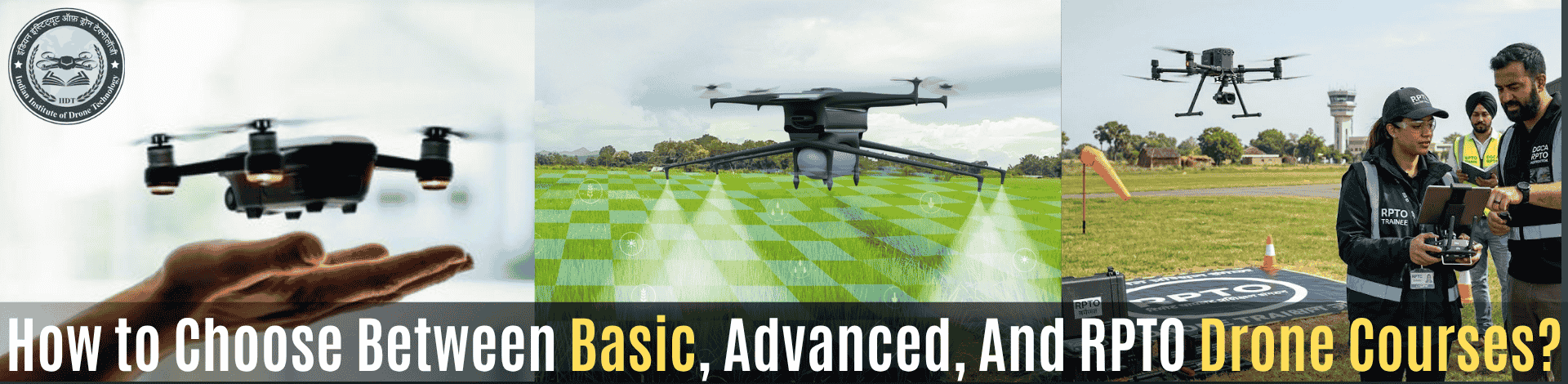
Choosing between basic, advanced, and RPTO drone courses depends on your career goal, with advanced and RPTO paths offering higher employability in India.
Are you unsure which drone course actually leads to a career, not just a certificate? This confusion is common among students entering the drone industry in India.
The market is expanding fast, but each course serves a different purpose. Some build awareness, others build skills, and a few unlock real opportunities.
Selecting the right Drone Certification Courses in India depends on your career intent, not course duration. The course you choose decides whether you learn drones or build a career in drones.
Basic vs Advanced vs RPTO: The Real Difference
Basic courses are ideal for exploration, not employability. Basic training introduces drone parts, controls, and safety rules. It aligns with awareness guidelines influenced by DGCA frameworks.
- Duration: 3 to 7 days
- Focus: fundamentals and safety
- Limited field exposure
- Low direct job conversion
According to 2026 reports, 60% of beginners start here, but less than 25% move into paid roles.
“Basic training creates familiarity, not professional readiness,” notes an aviation training advisory panel.
Advanced Drone Courses Create Skill-Based Employability
Advanced courses convert interest into usable industry skills. These programs include mapping, inspection, and field workflows using tools aligned with DJI and datasets inspired by ISRO use cases.
- Duration: 15 to 30 days
- Includes real-world scenarios
- Covers agriculture, infrastructure, and survey
- Improves employability by 30% to 60%
A 2026 trend analysis shows students with applied training secure opportunities faster than theory-only learners.
“Companies now hire for execution ability, not just certification,” says a faculty mentor from an IIT-linked drone lab.
Geospatial Training Is Where Careers Actually Begin
Drone careers become real when flying meets data applications. This is where Drone Geospatial Technology Training in India becomes critical. Institutes like Indian Institute of Drone Technology (IIDT) focus on mapping, GIS, and real project workflows.
- Required in land survey, mining, and agriculture
- Demand growing across infrastructure projects
- Focus on output accuracy and data use
- Strong link to government and enterprise projects
Here’s what the numbers reveal: Around 65% to 75% of drone roles now require some level of data interpretation.
Experts consider this a turning point because drone roles are shifting from operators to solution providers.
“Data understanding decides your value in the drone ecosystem,” says a geospatial training expert.
RPTO Training: The Compliance Gateway
RPTO training is required for commercial drone operations in India. Approved under DGCA guidelines, RPTO programs prepare students for licensed drone flying and enterprise-level deployment.
- Duration: 5 to 15 days
- Mandatory for commercial operations
- Focus on compliance and airspace rules
- Essential for enterprise roles
According to 2026 reports, over 80% of structured drone jobs prefer RPTO-certified candidates. Most companies overlook that certification alone is not enough without skill depth.
“Certification opens doors, but skills keep them open,” says a compliance expert from a DGCA-aligned training system.
Processing Skills Convert Flying Into Income
Processing skills transform raw drone data into usable output. A structured Drone Processing Course in India, such as those offered by the Indian Institute of Drone Technology, teaches data stitching, analysis, and reporting.
Modern workflows are also influenced by AI systems powered by companies like NVIDIA.
- Essential for mapping and inspection roles
- Improves project readiness
- Needed for reporting and analytics
- Enhances client-facing capabilities
Most students overlook that flying is only one part of the job. Output creation drives real income.
“Clients don’t pay for flying. They pay for results,” says a drone workflow consultant.
Conclusion
Choosing between basic, advanced, and RPTO drone courses is not about difficulty. It is about direction and outcome. The strongest path in 2026 is layered learning. Start with fundamentals, build practical skills, and then move into certification and specialization. The drone industry rewards those who go beyond flying. Because in the end, a drone may lift off the ground. But your career lifts off only when your skills do.
FAQs
1. Which drone course is best for beginners in India?
A basic drone course is best for initial exposure and understanding.
2. Is RPTO certification required for jobs?
Yes, most commercial drone roles require RPTO certification.
3. Can advanced drone courses help in getting jobs?
Yes, they provide practical skills required by employers.
4. Why should I learn drone data processing?
It helps you convert drone output into usable professional results.
5. Which institute offers advanced drone training in India?
Indian Institute of Drone Technology offers industry-relevant drone and geospatial training.
Leave a Comment
Your email address will not be published. Required fields are marked *

Comments